




AI makes financial analysis faster. But speed is worth little if every assistant works with different definitions, different budget versions and different adjustments.
An AI assistant without a controlled financial model does not reduce fragmentation. It speeds it up.
That is why we believe the future of finance does not start with a chatbot, but with one controlled financial model. AI may query that model and propose changes. The model calculates, keeps the history and makes every outcome traceable. And you decide.

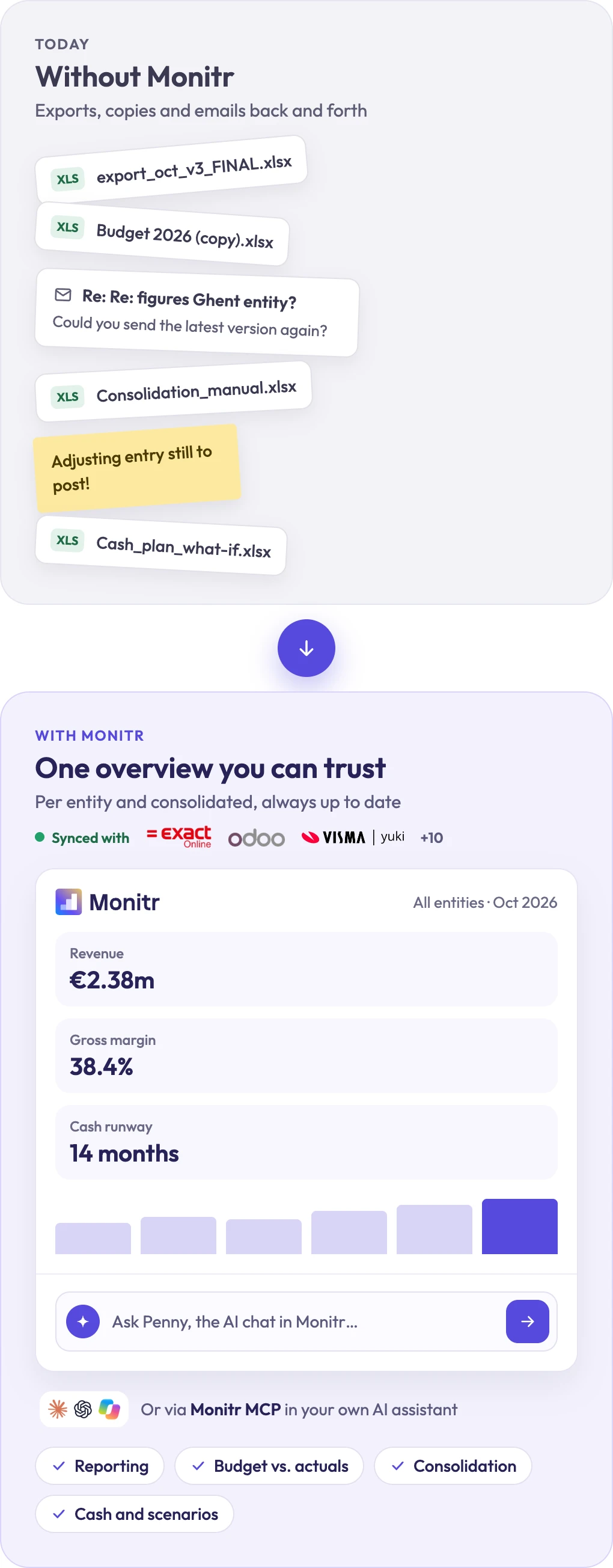
Fragmentation, only faster
Today, finance pieces its figures together. The accounting is the foundation, but the rest is scattered: your pipeline in your CRM, your people in your HR system, your budgets and adjustments in separate Excel files. It feels like always chasing the numbers.
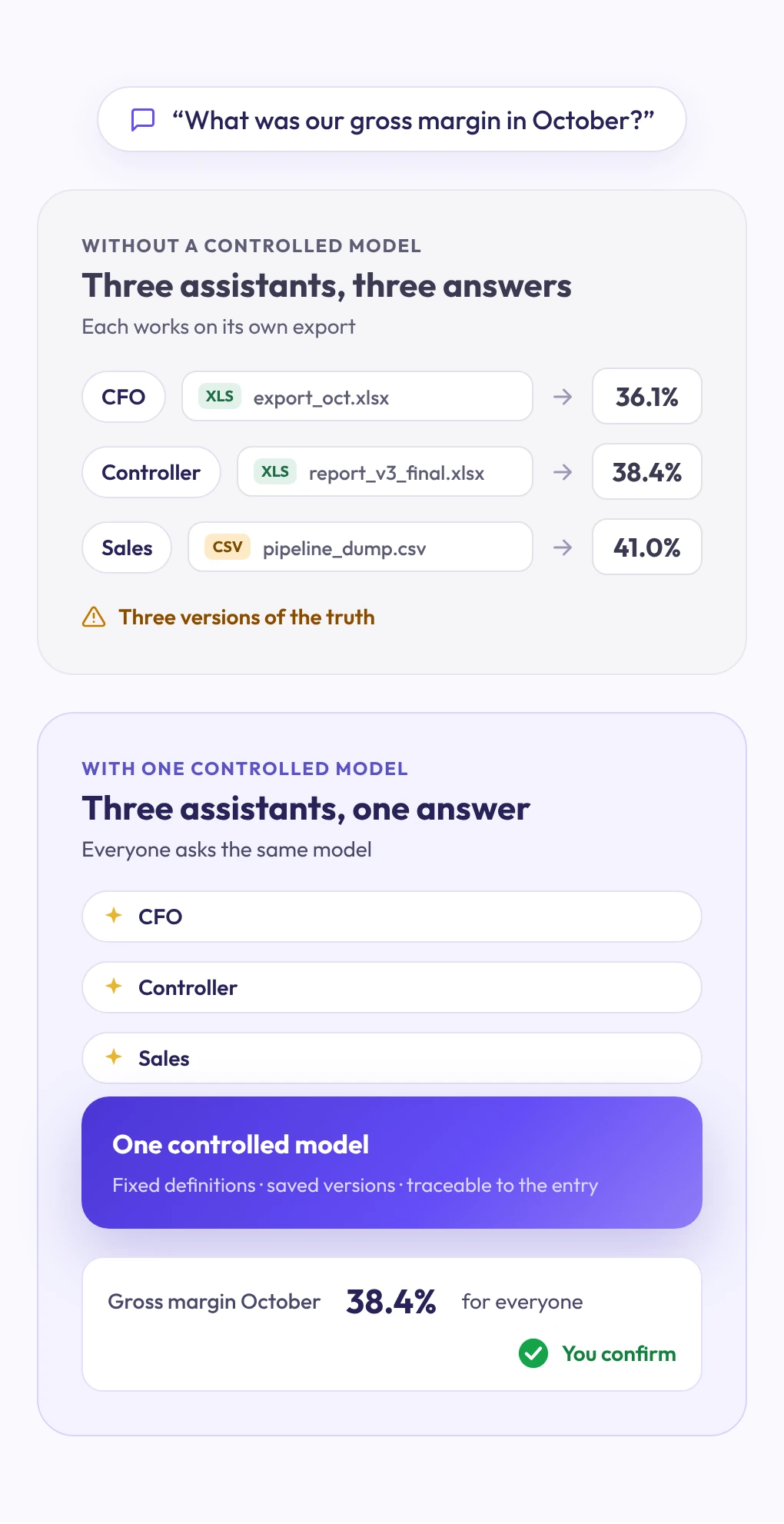
AI does not solve that by itself. Give an assistant an export and you get an answer in seconds. But your colleague with a different export gets a different answer. Every question produces a new version of the truth, just faster than before.
How finance is changing
We think AI will fundamentally change the work of finance in four ways over the coming years.
- From building reports to asking questions. The monthly report does not disappear, but the questions about it become more important. The answer comes straight away, from the same model.
- From an annual budget to a forecast that adjusts. Operational figures come in continuously and AI proposes adjustments. Your forecast stays current, instead of being out of date by March.
- One model for every assistant. Every AI assistant and every agent in your company gets its figures from the same model. Increasingly, that assistant also writes back, so data from your other tools ends up in the same source.
- The controller as reviewer. Collecting and reconciling shifts to AI. The controller spends their time on judging, adjusting and approving.
What those four have in common: the more AI does, the more important the model underneath becomes.
What that requires: one controlled model
As AI does more of the work, the model underneath has to become stronger. A single source of truth is then more than everything in one place. It requires five foundations:
- Unambiguous definitions. Gross margin, EBITDA or revenue per employee are defined once. After that everyone calculates with them, including AI.
- Version control. Every budget, forecast and scenario is kept, so you always know what you are comparing against.
- Traceability. Every figure can be traced back to the entry behind it.
- Access control. What someone is not allowed to see, their AI assistant does not see either.
- An audit trail. Every adjustment and every revised forecast stays visible: what changed, by whom and when.
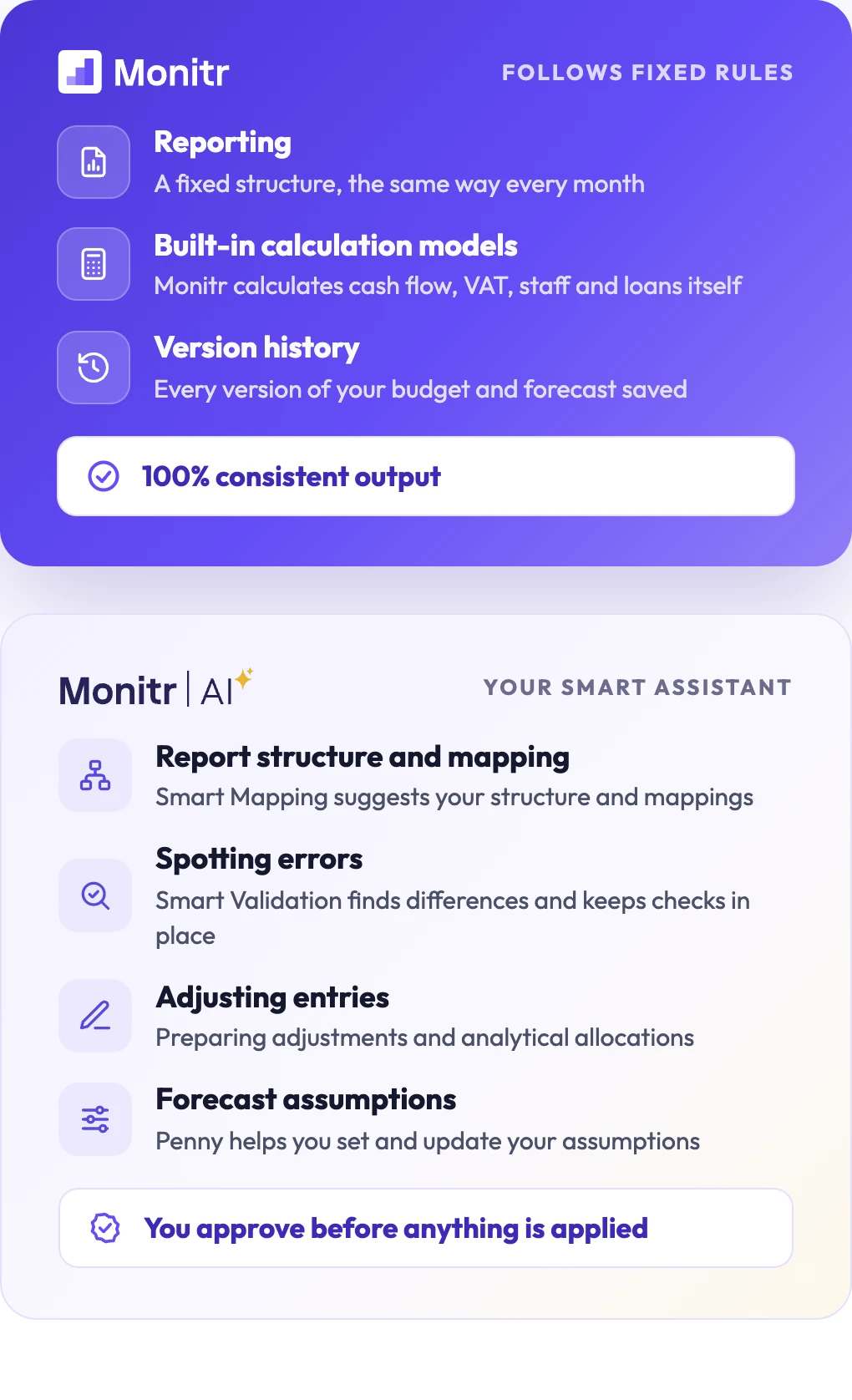
And it requires a clear division of tasks. A language model is probabilistic: it picks the most likely answer. That makes it strong at explaining, summarising and proposing. Financial software is deterministic: the same input always gives the same result. So let AI propose, let the model calculate and let people confirm.
That does not make AI flawless. A proposed assumption can be wrong, or a question misunderstood. But then the error lies in an assumption you can see and adjust, not in a calculation you cannot check.
How we put that into practice in Monitr
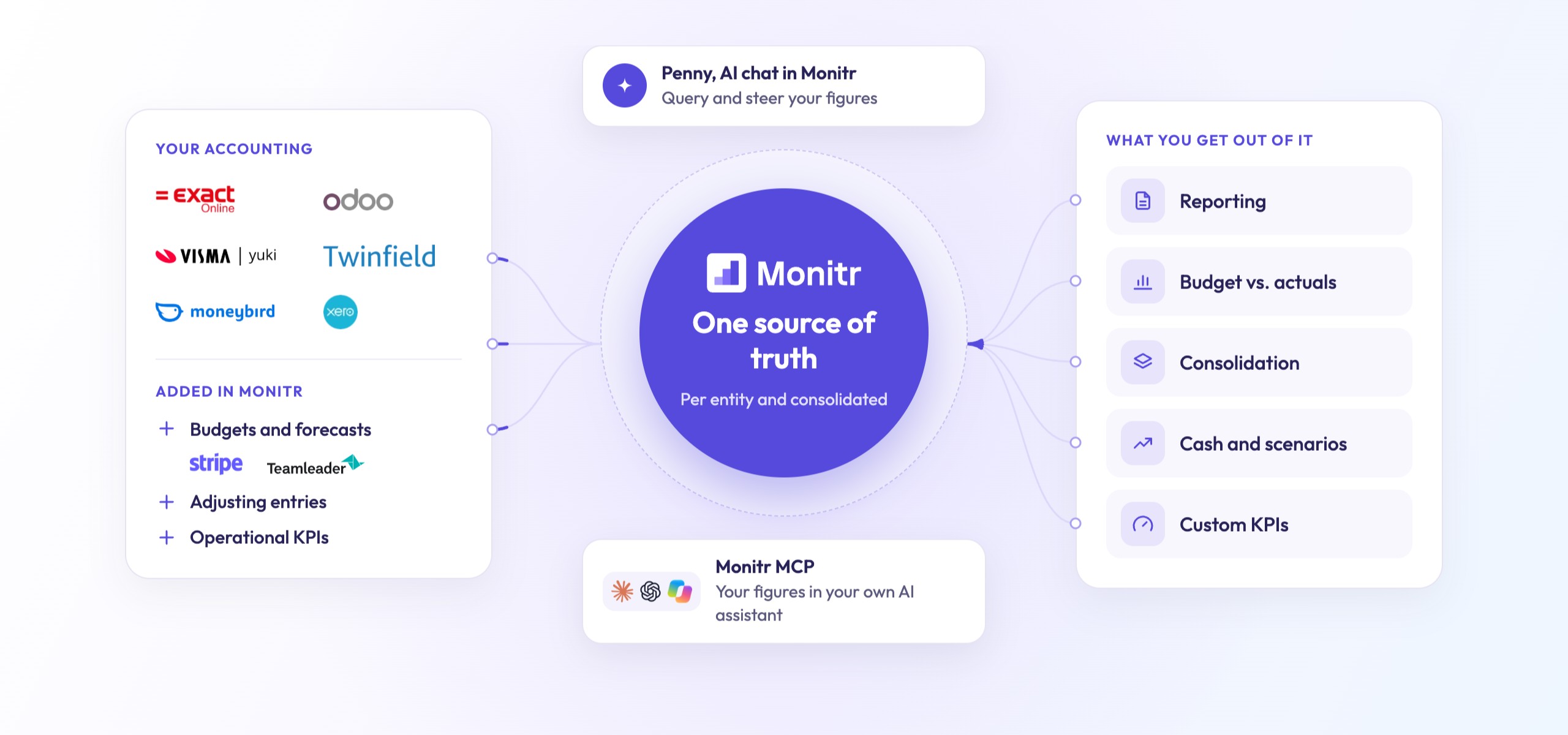
One model in Monitr
Monitr builds that model on four types of data:
- Your accounting. Monitr connects directly with Exact Online, Odoo, Yuki, Twinfield, Moneybird or Xero. AI turns your general ledger into a management report that fits your business.
- Your adjustments. You allocate costs per department or project, put an invoice that has not arrived yet in the right month, or spread an annual licence over twelve months, without your accounting changing.
- Your budgets and forecasts. Calculation modules for staff, revenue, VAT, working capital, fixed assets and loans, with data from your operational systems such as Stripe or Teamleader.
- Your operational KPIs. A SaaS company tracks its MRR and revenue per customer, an agency its billability and capacity, a web shop its stock and purchases. They come in through integrations, by entering them yourself or via your AI assistant.








 One source of truthPer entity and consolidated



Everything per entity and consolidated, even if your entities use different accounting packages. This is what the five foundations look like in Monitr:
- Unambiguous definitions. Your reporting structure, your mapping and your KPI formulas.
- Version control. Every version of your budget, forecast and scenario is kept.
- Traceability. You click through from report line to entry.
- Access control. Through the Monitr MCP, your assistant’s rights follow those of the user.
- Audit trail. Adjustments sit as separate entries next to your accounting: they stay visible and traceable. Changes via Penny or the MCP only come in after you confirm them.
Read more about reporting, budgets, adjusting entries and operational KPIs on our feature pages.
AI proposes, Monitr calculates, you confirm
With Penny, the AI chat in Monitr, or with the Monitr MCP in your own assistant, such as Claude, ChatGPT or Copilot, you ask your questions in plain language. Three examples:
- Adjusting a forecast. Has your billability been below budget for months? AI puts your KPIs next to your forecast and proposes a revised version.
- Running a scenario. In our demo file, Penny proposed a loan of €400,000 to bridge a temporary cash shortfall. Before processing anything, she asked about the term and the interest rate.
- Preparing an adjustment. Load your payroll report into your assistant and ask it to split the staff costs by department. AI proposes the analytical allocation and checks that the totals reconcile with the payroll report.
For example, ask: “Our billability has been below budget for three months. What does that mean for our revenue and cash this year?”
Monitr runs those proposals through fixed rules and calculation modules, for your reporting, your budget versus actuals, your consolidation and your cash forecast. You first see which period, amounts and assumptions change. Only after you confirm is the change processed.
How customers do it today
- SandGrain: reporting and budgeting in Claude. Fractional CFO Filip Polus builds the monthly reporting and the 2027 budget in Claude, on the figures from Monitr.
- PathoSense: a CEO who talks to his figures. CEO and co-founder Sebastiaan Theuns asks Claude his questions and gets answers from the company’s own figures, with the points of attention he would otherwise miss.
- Monitr experiment: having the month-end close reviewed. In our own experiment an assistant prepares the close. In a test file it found a provision of €4,800 that had never been reversed.

“We now build our monthly management reporting and the 2027 budget directly in Claude, on the figures from Monitr. No exports, no copy-paste: we ask the question and carry on straight away with correct figures. It worked from day one.”
Filip Polus · Fractional CFO at SandGrain
Faster with AI, confident in your figures
AI is going to change how finance works. Whether that leads to better decisions depends on what lies underneath. We are building Monitr as that foundation: one controlled model, on which AI may propose, Monitr calculates and you decide.
Curious what that looks like for your business?


Pieterjan van Dam


